psychomare
This output is interpretive artwork criticism only and not clinical diagnosis or therapy advice.
01 / About this report
FILE: ABOUT.TXT · READThis report is an interpretive and critical reading for Computational Media Artworks (CMAs). It uses the Subject-Structure-Discourse (SSD) framework, adapted from Lacanian psychoanalytic concepts, as an additional lens for understanding how an artwork operates. It is not a quality rating or value judgment of the work.
SSD approaches the artwork as an active subject that organizes concept, medium, discourse, and social bond in public form. The goal is to help artists, curators, and viewers access a psychoanalytic reading that clarifies what the work is doing. This model currently applies to CMA works and does not cover every category of art.
02 / Artwork Overview
FILE: ARTWORK_OVERVIEW.TXT · READSplit Subject
Neurotic-leaning artwork
The discourse of Artwork
03 / Subject Layer
FILE: SUBJECT.TXT · READThe Split Artwork ($)
Read the artwork as split in two layers: what it clearly shows and what it implies. Pay attention to the gap between these layers, where tension and contradiction often emerge.
Explicit Statement
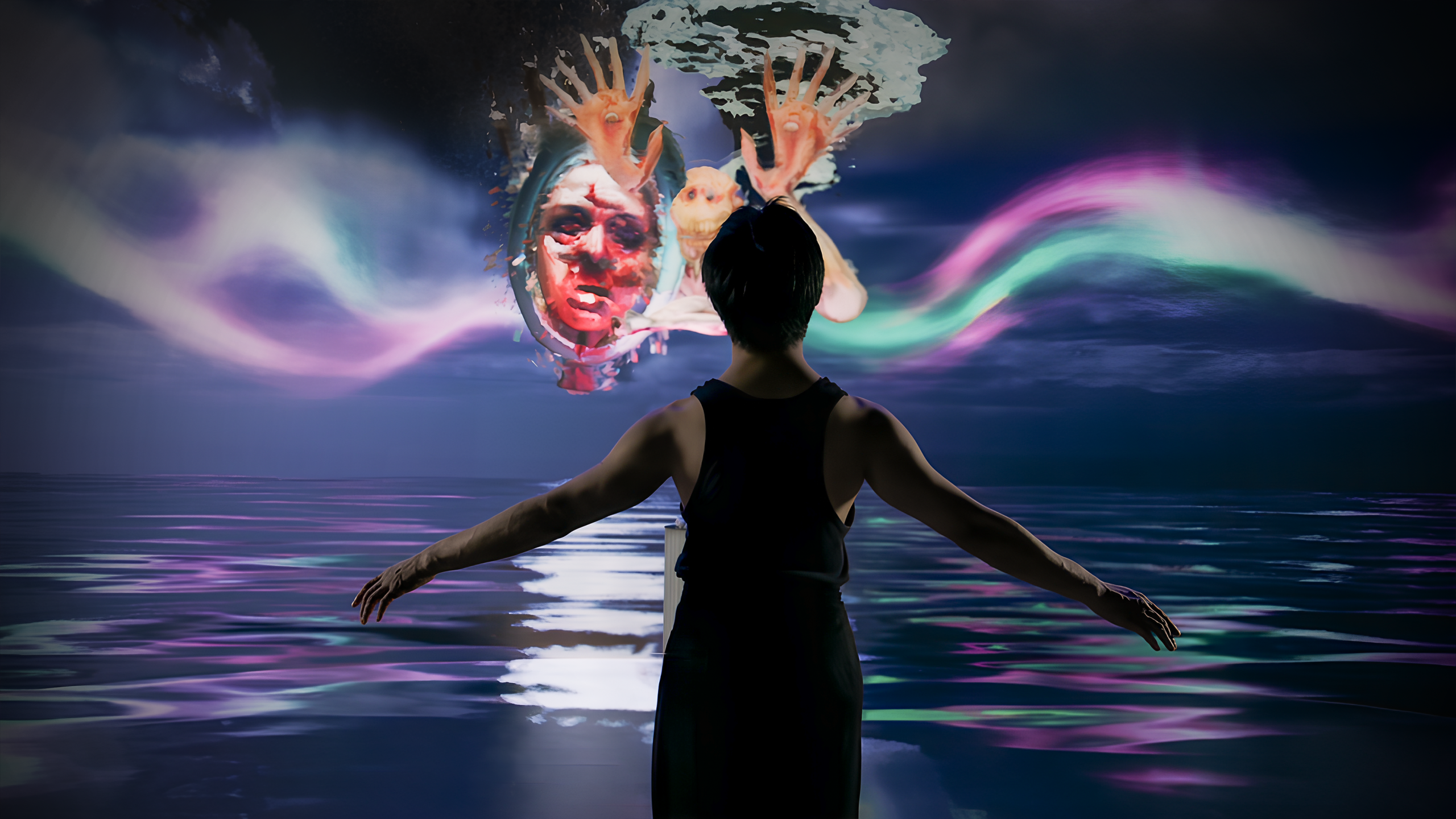
The artwork explicitly presents a psychoanalytic XR dance film where a dancer moves through a virtual, oceanic landscape. Nightmares are visualized as particle-based fragments that swirl and interact with the dancer’s body, inviting an embodied encounter with psychological fears.
Evidence: DescriptionSet in an oceanic landscape of the unconscious, dancer Peng Zhou moves as an intermediary between tangible dream objects and their virtual nightmare counterparts.Each encounter with these entities triggers subtle yet intense emotional disturbances, visualized as particle-based fragments that swirl around and collide with the body.
Implicit Enunciating
Beyond its surface, the work implies a process of facing and integrating one's unconscious fears, reframing nightmares as opportunities for embodied understanding and personal growth.
- Encourages viewers to move from avoidance to acceptance of internal anxieties.
- Suggests confronting nightmares can lead to greater empathy and self-awareness.
- Uses immersive aesthetics to facilitate emotional and psychological engagement.
Subject of Desire
Read the work through the Need-Demand-Desire chain: what motivates the work, what artistic means it asks for, and what unresolved remainder continues to drive it.
The Need
The project addresses the fundamental urge to confront unconscious fears, highlighting the necessity of acknowledging and understanding psychological disturbances rather than suppressing them.
- Addresses the human need to recognize and accept psychological misrecognition.
- Responds to social and emotional urgencies surrounding mental wellness.
- Highlights the value in experiencing and processing what is typically repressed.
The Demand
The work’s motivations are pursued through the blending of XR dance, virtual production, and particle-based visualization, giving form to nightmares and their emotional impact.
- Employs dance to mediate between dream and nightmare objects.
- Uses virtual production and AI-generated imagery to visualize psychological states.
- Materializes emotional disturbances through particle-based effects.
The Desire
An open tension remains between the urge to resolve nightmares and the gentle act of accepting them. The work leaves the integration of these fears forever incomplete and ongoing.
- Full reconciliation with unconscious fears is never fully achieved.
- The dance between confrontation and acceptance remains dynamic.
- Nightmares retain ambiguity as both threat and site of transformation.
The Object-a
The swirling, particle-based fragments that repeatedly interact with the dancer’s body serve as the enigmatic attractor in the work—tangible yet ambiguous signs of psychological disturbance.
- Visually represent emotional responses and nightmare residue.
- Appear at each confrontation between dancer and nightmare object.
- Remain unresolved, never fully integrated into the dancer’s movement.
The Drive
The experience loop is built on the recurring process of the dancer meeting and responding to nightmare manifestations, generating continuous cycles of emotional turbulence and acceptance.
- Dancer encounters each new nightmare object in sequence.
- Each meeting triggers a new swirl of particles, sustaining the emotional loop.
- Cycle replays, denying a final resolution to the emotional conflicts.
The Jouissance
Read jouissance as the work's satisfaction effect: how it fulfills or exceeds expectations for artist and audience, beyond simple enjoyment.
Explicit enjoyment
The film’s technical execution delivers a visually rich encounter with psychological content, blending virtual choreography and digital aesthetics to a high level of polish.
Spectators can directly appreciate the lush and immersive environments where particle effects and dance actions are intricately integrated.
- Polished integration of AI-driven visual effects and dance movement.
- Seamless choreography between digital elements and human performer.
- Striking use of particle effects to symbolize emotional states.
Implicit enjoyment
Viewers experience subtle satisfaction not only in the work’s aesthetics but also from its invitation to self-reflect on their own fears and vulnerabilities.
The conceptual strategy yields resonance by proposing an alternative to repression: a transformative encounter with unconscious materials, fostering empathy and deeper understanding.
- Invites self-reflection on unconscious anxieties.
- Transforms passive viewing into active psychological engagement.
- Supports collective empathy through shared confrontation of fear.
04 / Structure Layer
FILE: STRUCTURE.TXT · READThe formalization
Read formalization as the process that turns an intangible impulse into a shareable CMA artifact through recognizable artistic grammar: legible media carriers, interaction mechanisms, and technical protocols.
The Censorship
Read censorship as the filtering process that makes a work publicly readable through three forces: separation from the artist, platform or institutional framing, and wider public feedback.
Author separation
Jiayang Huang’s work is shaped by a sustained engagement with psychoanalytic theory, the unconscious, and the intersection of technological and artistic media. Her research interest in subjectivity and the mind's internal landscapes provides a consistent thread across her practice, guiding the translation of internal psychological states into immersive, media-driven experiences. This commitment directs 'psychomare' toward revealing internal fears through virtualized, embodied forms.
- Focuses on psychoanalysis, especially the unconscious and subjective experience of fear.
- Blends research methods from technology and art to explore new perceptual possibilities.
- Aims to translate internal states into shareable, embodied art forms rather than remain purely personal.
Evidence: BiographyJiayang’s research lies at the intersection of artistic practice, technological media, and psychoanalysis, with a particular focus on individual subjectivity and the unconscious mind.
Platform ideology
The platform frames 'psychomare' as a conceptual and aesthetic exploration where nightmares function as symbolic misrecognitions translated into immersive choreography. Institutional feedback values how this structure allows emotional resonance and collective engagement, prioritizing works that facilitate reflection and empathy by making psychological content public. The project’s alignment with curatorial logic is evident in how formal strategies transform private fears into accessible, impactful visual experiences.
- Emphasizes symbolic misrecognition as a guiding logic for choreography and visuals.
- Jury and curatorial feedback note strong emotional resonance, encouraging viewer identification.
- Platform promotes the transformation of psychological processes into shared, readable art forms.
Evidence: PlatformFeedback from the dancer, audience, and a psychoanalyst reveals strong emotional resonance and aesthetic depth, suggesting that the visualization of nightmares can foster self-reflection, emotional confrontation, and collective empathy.
Other reviews
External/public feedback traces are limited, so the following is AI feedback: The work positions nightmares not as adversaries to be defeated, but as facets of the psyche to be explored and gently understood. Its approach fosters an atmosphere where viewers shift from avoidance to acceptance, enabling collective reflection on fear and the unconscious within a shared, virtualized space.
- Artwork shifts the trope from defeating nightmares to gently facing inner fears.
- Invites embodied understanding through immersive visual and choreographic means.
- Encourages collective and individual reflection on psychological themes via public presentation.
Evidence: DescriptionRather than “defeating” nightmares, the film invites viewers to face and gently accept their unconscious fears, suggesting a shift from avoidance to embodied understanding.
Structure mode
Read structure mode as a classification of the concept-form relation after formalization and censorship: Psychotic-leaning (concept > form), Perverse-leaning (form > concept), or Neurotic-leaning (form approximately concept).
Mode type
The formalization in 'psychomare' balances conceptual intention and public readability. The choreography, digital particle effects, and psychoanalytic framing are tightly interwoven to ensure the viewer can both grasp and experience the emotional stakes of the work, fostering comprehension rather than obscurity or mere spectacle.
Techniques like embodied dance and AI-generated visual fragments enable the abstract psychoanalytic idea of nightmares to translate into a communicable structure. Rather than prioritizing either raw personal symbolism or technical virtuosity, the method serves the intention, resulting in coherent reception by both specialized and general audiences.
Evidence: Description, PlatformSubtype
The artwork leaves its journey through nightmares open-ended, refraining from imposing a definitive resolution or closed structure. This poetic approach keeps the rhetorical space ambiguous, inviting the audience to remain engaged with the productive tensions of the unconscious rather than tidily resolving psychological disturbance.
Such openness aligns with the hysteric subtype: meanings are in flux, answers are intentionally deferred, and the participant is left to imagine, speculate, and reflect. The structure-productively resists closure, allowing the work to continually generate new associations in viewers’ minds.
Evidence: Description05 / Discourse Layer
FILE: DISCOURSE.TXT · READFour elements
Read the work through four discourse elements: S1, S2, a, and $. In 3.1.1-3.1.4, assign one primary candidate to each element by building on the Subject Layer (1.0) and Structure Layer (2.0). These elements work together as one system for reading how the artwork speaks.
Master signifier (S1)
The work is decisively anchored in its distinctive choreography of encountering and visually processing nightmare imagery within an immersive XR environment. This specific sequence of dancer’s movements amidst swirling digital fragments fuses psychoanalytic theme and digital medium into an immediately recognizable form. The entire experience is oriented around making the process of confronting inner fear materially and visually present.
Evidence: Description, PlatformKnowledge (S2)
The conceptual engine making the project legible is the system of psychoanalytic visualization—both as psychological theory and as aesthetic production logic. Nightmares are staged not for their dramatic excess but through a structure drawn from psychoanalysis, transforming internal misrecognition into observable, embodied sequences. This theory-informed system guides the choreography, the digital technique, and the interpretive approach for both dancer and viewer.
Evidence: Biography, PlatformEnigma (a)
The work’s enigmatic core is found in the swirling, particle-based fragments that encircle and respond to the dancer's body. These digital phenomena are neither entirely abstract nor wholly explained—they serve as both sculptural residue and active agent of psychological disturbance. Their persistent interaction with the dancer keeps viewers transfixed on what remains indeterminate: the form and effect of our own unconscious fears.
Evidence: DescriptionContradictions ($)
The central contradiction animating the piece is the tension between avoidance and acceptance in relation to unconscious fears. The encounter with nightmares is not resolved through eradication or cathartic transformation, but through an uneasy oscillation between the temptations to turn away and the invitation to embrace what disturbs us. This dynamic grants the work its sustained psychological charge and productive ambiguity.
Evidence: Description, PlatformPositions
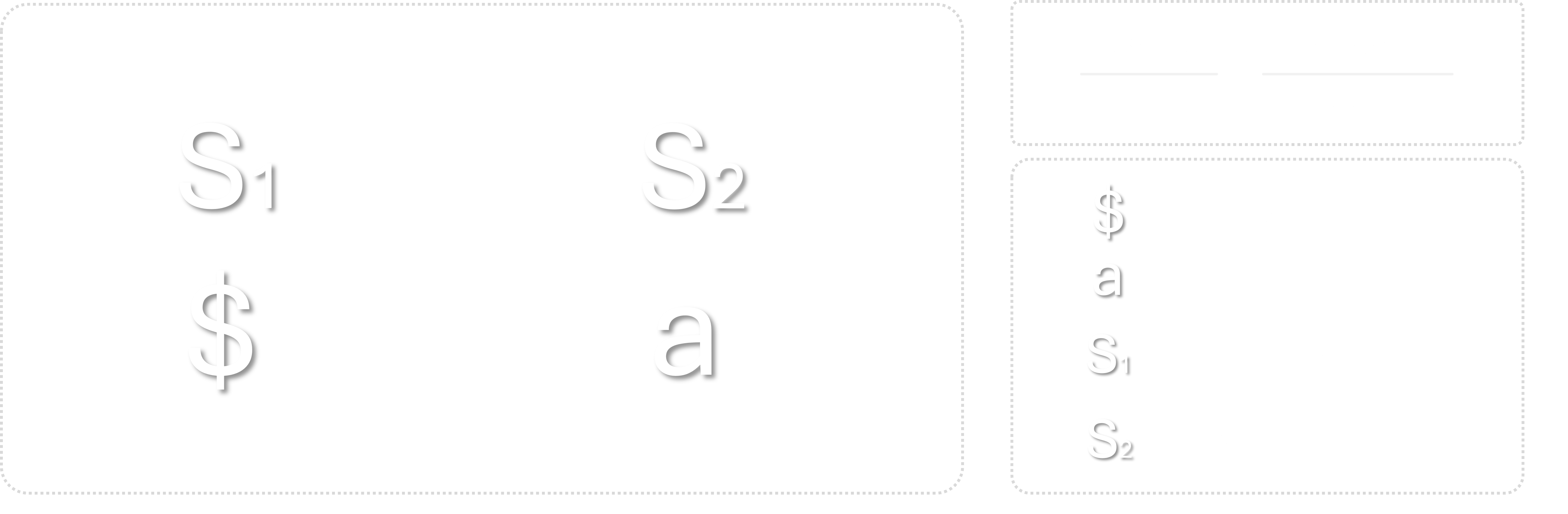
Read Agent - Other - Production - Truth as a fixed discourse vector: the stable route through which discourse is organized. Agent initiates, Other is addressed, Production is generated, and Truth remains the hidden driver. This step maps S1, S2, a, and $ into these positions to reveal the discourse pattern.
Discourse of artwork
Read this step as choosing the artwork's dominant speaking style: Signature, Archive, Scribble, or Errata. Judge it through two linked views: what leads in the discourse (style, knowledge, contradiction, or enigma), and which element takes structural lead (S1, S2, $, or a). Together, these cues identify the pattern that most strongly organizes the work.
Discourse Type
The dominant discourse structure of ‘psychomare’ is that of Signature: the work’s agent position is occupied by a singular, expressive choreography (‘nightmare encounter choreography’) that operates as a commanding mode of address to both performer and viewer. The psychoanalytic visualization system serves as the Other—its rationality and interpretive order authorize the artist’s chosen frame and guide the meaning audience members are asked to accept. Swirling particle fragments, as the enigmatic residue of the process, are the production outcome, crystallizing the psychodynamic process into sensuous, yet unresolved, digital phenomena. At the root remains avoidance vs acceptance—a split truth that the masterful framing can never entirely resolve, but which gives the artwork its lasting psychological and aesthetic grip.
Evidence: Description, Platform, Biography