Ephemera
This output is interpretive artwork criticism only and not clinical diagnosis or therapy advice.
01 / About this report
FILE: ABOUT.TXT · READThis report is an interpretive and critical reading for Computational Media Artworks (CMAs). It uses the Subject-Structure-Discourse (SSD) framework, adapted from Lacanian psychoanalytic concepts, as an additional lens for understanding how an artwork operates. It is not a quality rating or value judgment of the work.
SSD approaches the artwork as an active subject that organizes concept, medium, discourse, and social bond in public form. The goal is to help artists, curators, and viewers access a psychoanalytic reading that clarifies what the work is doing. This model currently applies to CMA works and does not cover every category of art.
02 / Artwork Overview
FILE: ARTWORK_OVERVIEW.TXT · READSplit Subject
Neurotic-leaning artwork
The discourse of Artwork
03 / Subject Layer
FILE: SUBJECT.TXT · READThe Split Artwork ($)
Read the artwork as split in two layers: what it clearly shows and what it implies. Pay attention to the gap between these layers, where tension and contradiction often emerge.
Explicit Statement
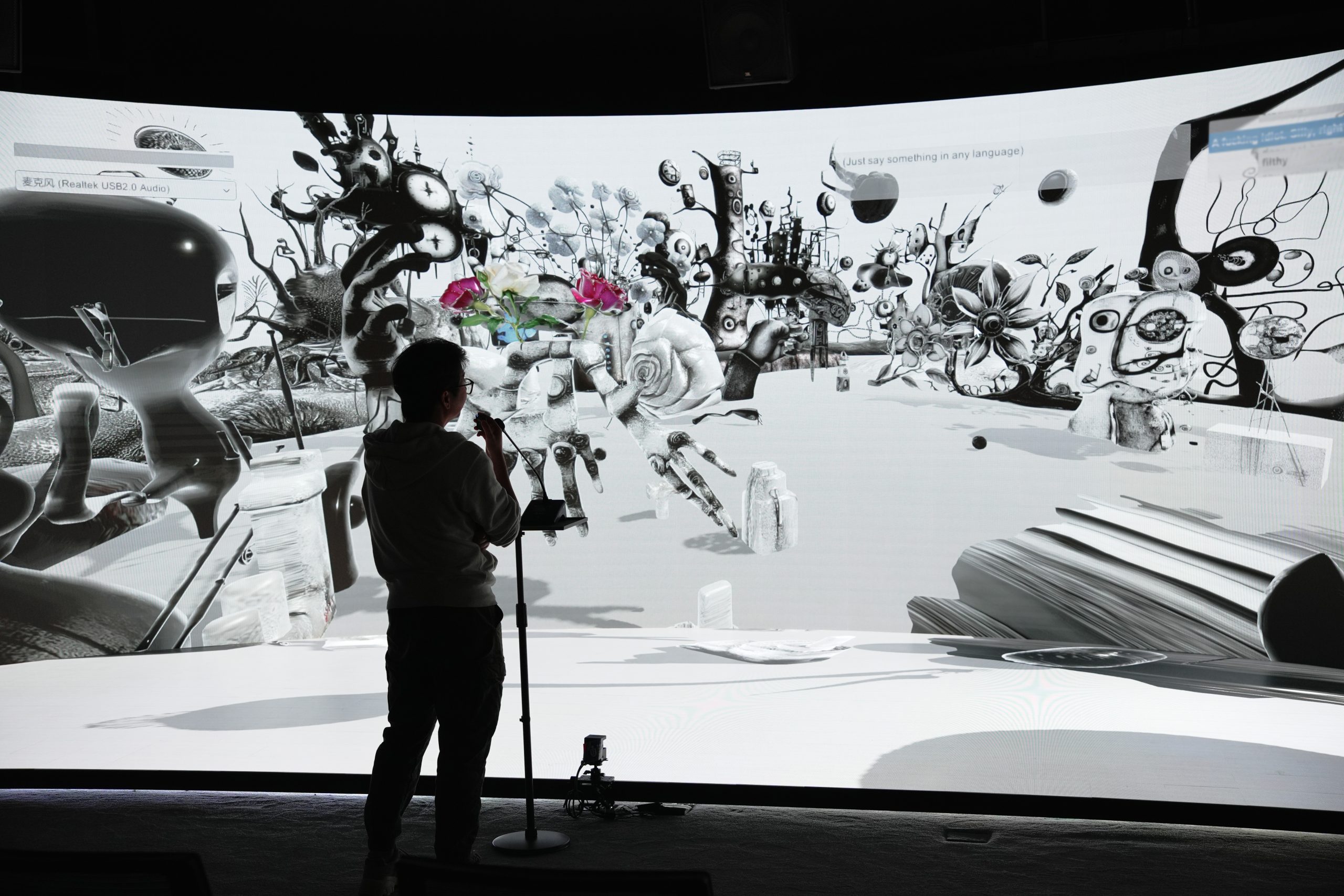
Ephemera is an AI-driven interactive art installation that processes participants' speech and visualizes linguistic taboos within a generative digital ecosystem. The work utilizes advanced technologies to create an immersive environment where audience interaction drives the system's visual and behavioral responses.
Evidence: DescriptionEphemera is a speech-based interactive and immersive installation, that responds to the linguistic taboos encountered in daily communication, prompting audience reflection and thoughts.We aim to confront audiences with the power of language through visualization, prompting introspection regarding unconscious discourse in daily interactions or social media.
Implicit Enunciating
Beyond its surface, Ephemera critically interrogates the psychological and social mechanisms of censorship and linguistic taboos. It leverages technology to expose the hidden power dynamics and unconscious biases embedded in everyday language.
- Illuminates the subconscious effects of societal norms around language.
- Explores the intersection of AI, art, and cultural discourse on taboo.
- Provokes reflection about censorship and the role of technology in mediating expression.
Subject of Desire
Read the work through the Need-Demand-Desire chain: what motivates the work, what artistic means it asks for, and what unresolved remainder continues to drive it.
The Need
The work responds to the urgent necessity to address and reflect upon the pervasive influence of language, especially taboos, in shaping individual and collective consciousness.
- Heightens awareness of everyday linguistic norms.
- Motivates deeper inquiry into unconscious communication patterns.
- Addresses the psychological impact of taboo language in society.
The Demand
The artistic demand is realized through the use of AI-driven technologies that analyze, classify, and visually manifest language, making the artwork's response both adaptive and immersive.
- Utilizes speech processing and taboo classification.
- Generates visual representations from audience input.
- Builds an autonomous digital ecosystem to embody language phenomena.
The Desire
There is an unresolved desire to truly confront and catalyze audience introspection about language's latent forces and taboos which technology alone cannot fully materialize.
- Technology can simulate, but not resolve, inner reflection.
- True understanding of unconscious discourse remains elusive.
- The installation leaves open the transformation of private awareness into public change.
The Object-a
The recurring attraction is the surreal, AI-generated 'virus' representations—visual manifestations of taboo words—inhabiting the digital ecosystem. These forms remain enigmatic and unsettling in their persistent yet morphing presence.
- Embodies taboo as visible, mutable entities.
- Their presence continually draws viewer focus.
- Their exact meaning and limits evade full explanation.
The Drive
Audience speech continuously activates and transforms the digital ecosystem, perpetuating an endless cycle of input and generative response that drives the installation's experience.
- Participant input is perpetually analyzed and visualized.
- Each interaction reinvigorates the digital ecosystem.
- The work never settles but evolves through ongoing participation.
The Jouissance
Read jouissance as the work's satisfaction effect: how it fulfills or exceeds expectations for artist and audience, beyond simple enjoyment.
Explicit enjoyment
Ephemera delivers sensory and technical satisfaction through its highly crafted digital visuals and seamless reactive environment, engaging audiences both visually and interactively.
Viewers experience an immersive multimedia space where technological precision and dynamic visual feedback amplify the sensation of participation.
- Striking visualizations maintain immersive engagement.
- Interactive system responds smoothly to every utterance.
- Sophisticated AI infuses the installation with credibility and immediacy.
Implicit enjoyment
Conceptually, the work gratifies by provoking thoughtful encounters with language's invisible frontiers and inviting audiences to reflect on their complicity in perpetuating taboos.
Participants gain intangible satisfaction from engaging in a thoughtful, technologically mediated dialogue about speech, censorship, and self-awareness.
- Delivers reflective reward on social and linguistic issues.
- Invites novel perspectives on the role of art and technology.
- Expands intellectual curiosity about censorship and the unconscious.
04 / Structure Layer
FILE: STRUCTURE.TXT · READThe formalization
Read formalization as the process that turns an intangible impulse into a shareable CMA artifact through recognizable artistic grammar: legible media carriers, interaction mechanisms, and technical protocols.
The Censorship
Read censorship as the filtering process that makes a work publicly readable through three forces: separation from the artist, platform or institutional framing, and wider public feedback.
Author separation
The author’s direction is rooted in investigating how language's power, particularly around taboo and the unconscious, can be engaged through technological mediation. This work builds upon the artist’s ongoing research into the intersections of artistic practice, subjectivity, and advanced computation, using art as both lens and agent of psychological inquiry. The approach directly connects medium, method, and conceptual agenda, ensuring a personally invested and research-driven project.
- Focuses on psychoanalytic themes—subjectivity, the unconscious, and societal discourse.
- Employs technology (AI, generative systems) as an artistic and analytical tool.
- Emphasizes introspection about language norms and their psychological effects.
Evidence: DescriptionWe aim to confront audiences with the power of language through visualization, prompting introspection regarding unconscious discourse in daily interactions or social media.
Platform ideology
The platform frames 'Ephemera' as a technologically immersive encounter with social taboos and censorship, linking its significance to psychological and cultural conditions in a post-pandemic context. The emphasis is on the use of AI and the metaphor of language as a virus to spotlight the spread and psychological impact of banned words. This curatorial lens values the work’s alignment with institutional priorities around technology-driven reflection and dialog.
- Spotlights immersive technological engagement with taboo and censorship.
- Applies the 'language as a virus' framework to understand social impact.
- Connects artistic exploration to broader psychological and cultural issues.
Evidence: PlatformThis paper presents Ephemera, an AI-driven interactive art installation that explores linguistic taboos and censorship through immersive technology.
Other reviews
External/public feedback traces are limited, so the following is AI feedback: The artwork effectively leverages interactivity and visualization to foster audience reflection on unconscious language and taboo. Its interface and system design make complex social and psychological issues broadly accessible, translating abstract themes into tangible, shared experience. The consistent integration of technology with artistic intent invites public introspection rather than dictating interpretation.
- Interactivity prompts participants to reflect on hidden language patterns.
- Visualization of taboo terms renders abstract concepts experientially vivid.
- Open-ended presentation encourages individual interpretation and discussion.
Evidence: DescriptionWe aim to confront audiences with the power of language through visualization, prompting introspection regarding unconscious discourse in daily interactions or social media.
Structure mode
Read structure mode as a classification of the concept-form relation after formalization and censorship: Psychotic-leaning (concept > form), Perverse-leaning (form > concept), or Neurotic-leaning (form approximately concept).
Mode type
The structure of 'Ephemera' demonstrates a neurotic-leaning mode, with the conceptual narrative of language as contagion precisely mapped onto an interactive artistic grammar that viewers can navigate. The artist's formal mechanisms (AI processing, generative visualizations) create a directly interpretable link between user input, taboo themes, and visual output.
Rather than allowing either form or concept to dominate, the work’s rules, metaphors, and public display continually reinforce the intended discourse. This allows audience members to meaningfully engage with the project’s themes and supports a coherent, accessible experience.
Evidence: Description, PlatformSubtype
The rhetorical structure of 'Ephemera' leans toward a hysteric subtype, as it prioritizes productive ambiguity and ongoing inquiry over final answers. Its interactive visualizations and metaphoric framing of language as virus invite audience introspection and open-ended interpretation.
Although structured, the system stops short of delivering a clear solution or closed mapping: instead, each participant’s input reframes the piece and keeps the discourse generative. The artwork thus leaves space for continuously renewed questioning rather than imposing a singular reading.
Evidence: Description05 / Discourse Layer
FILE: DISCOURSE.TXT · READFour elements
Read the work through four discourse elements: S1, S2, a, and $. In 3.1.1-3.1.4, assign one primary candidate to each element by building on the Subject Layer (1.0) and Structure Layer (2.0). These elements work together as one system for reading how the artwork speaks.
Master signifier (S1)
The work establishes itself as a 'Taboo Virus Ecosystem,' succinctly capturing both its conceptual and visual framework. This phrase encapsulates the recurring motif of language considered as contagious, visualized through a thriving digital micro-organism world shaped by audience interaction. It signals the recognizable identity under which the artwork invites participation and recognition.
Evidence: Description, PlatformKnowledge (S2)
The underlying knowledge system is an 'AI Censorship Taxonomy'—a structure that integrates machine learning, speech recognition, and generative models to classify and actualize verbal taboos. The system operationalizes and legitimizes the work by providing technological means to detect, sort, and visualize forbidden language, transforming conceptual taboos into codified digital entities.
Evidence: Platform, DescriptionEnigma (a)
The enigmatic focal point of the installation is the constantly shifting, surreal AI-generated visualizations of language-virus forms. These biomorphic digital entities tantalize viewers with their persistent mutability and lack of a fixed referent, drawing attention to what resists explicit systematization even as everything else is categorized.
Evidence: DescriptionContradictions ($)
A central contradiction energizes the work: the drive to classify language through technological systems versus language's fundamentally unconscious, elusive, and affect-laden qualities. The audience confronts the tension between systematized control and the wild, unpredictable flow of taboo and meaning that resists full codification.
Evidence: DescriptionPositions
Read Agent - Other - Production - Truth as a fixed discourse vector: the stable route through which discourse is organized. Agent initiates, Other is addressed, Production is generated, and Truth remains the hidden driver. This step maps S1, S2, a, and $ into these positions to reveal the discourse pattern.
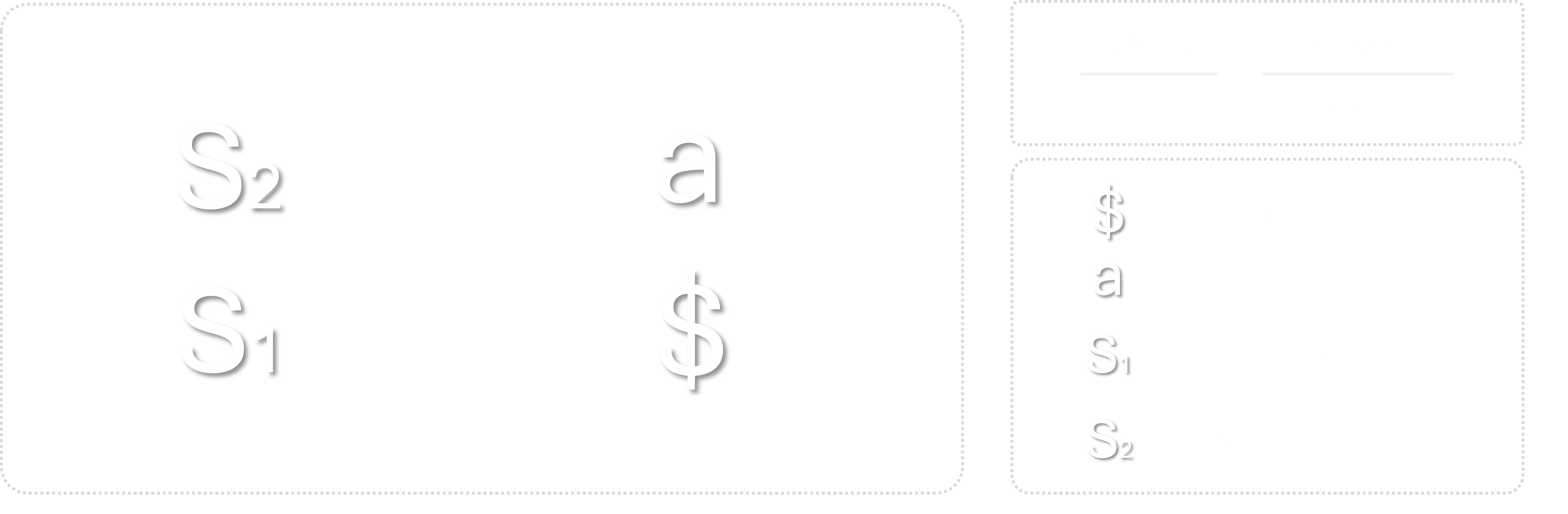
Discourse of artwork
Read this step as choosing the artwork's dominant speaking style: Signature, Archive, Scribble, or Errata. Judge it through two linked views: what leads in the discourse (style, knowledge, contradiction, or enigma), and which element takes structural lead (S1, S2, $, or a). Together, these cues identify the pattern that most strongly organizes the work.
Discourse Type
Ephemera most coherently addresses the viewer in the Archive discourse mode. Here, the 'AI Censorship Taxonomy' acts as the Agent, organizing perception and participation through a robust technological classification system. Viewers find themselves occupying the position of the Other, whose contributions—speech and unconscious discourse—are absorbed, sorted, and visualized as the enigmatic virus forms (a). This systematic processing generates the key division (Systematization vs Unconscious flux), imposing a structural gap between digital order and psychic complexity. Ultimately, the underlying truth anchoring the work is the desire to name and frame all language through the ecosystem’s 'Taboo Virus' signifier, illuminating how knowledge-systems both reveal and discipline what is enigmatic in language.
Evidence: Description, Platform